Fun Facts In Chemical Engineering

We all are surrounded by chemicals in our life. We handle a lot of chemicals nearly everyday, unknowingly. A variety of chemical processes are going on around us, and we perform some of them ourselves, and we don't even realize! Read on to understand the different fun facts of chemical engineering!
- Lakes freeze from top to bottom:

- As the surface water of the lake cools and reaches 40C, its density increases.
- This colder, denser water sinks, displacing the warmer, less dense water at the bottom, which then rises to the surface to be cooled.
- This continues until the entire body of water is near 40C.
- Water reaches its maximum density at 40C, hence it settles down.
- Cooling from 40C to 00C is called the anomalous expansion phase, in which the density decreases.
- Water molecules begin to form an open lattice-like structure in preparation for freezing, which takes up more space and makes the liquid dense.
- A needle floats on water:
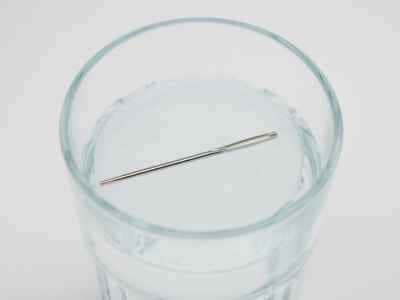
- A needle floats on water because of its surface tension.
- When the needle is placed gently on the water's surface, the cohesive forces between water molecules create a flexible, stretched membrane (aka skin formation) that supports the needle's weight.
- The upward forces of this stretched surface, due to surface tension, balance the downward force of gravity acting on the needle.
- Other fun facts based on the same phenomenon are - leaves floating on water, mosquitoes lay eggs on water surface, adding sulfur powder to urine sample to check for the presence of bile - if it floats, no bile present but if it floats, then bile is present, which means it could be jaundice.
- Astronauts can drink water on the moon:

- The most common way astronauts drink water, both on the Moon and in orbit, is by using sealed collapsible pouches and straws equipped with one-way valves.
- The water is contained in a pouch, which is a closed system.
- The astronaut uses a special straw to suck the water out of the pouch. This suction is necessary because there's no strong gravitational pull to make the liquid flow downward or towards the opening of a container.
- The sucking of water from a straw is based on the phenomenon of capillary action, which you will study in details in Fluid Mechanics.